


Rise of the agentic engineer
Rise of the agentic engineer
Shipping software has fundamentally changed. Agentic engineering is taking over, and software engineers’ responsibilities have shifted significantly.
In this blog I’ll summarise what agentic engineering is, why it’s significant, and why it’s beneficial for everyone.
What changed

In case you didn’t hear, LLMs are kind of a big deal. The world is realising software is a perfect candidate for the generative text output LLMs produce. There’s a ton of training material from open source repositories, and the output is verifiable — if the app works then you can somewhat verify it’s doing a good job.
Recent milestones (in the last 6 months!):
- Terminal-first agentic interfaces like Claude Code and Codex went mainstream
- Cursor hit $1B ARR and shipped their own foundation model, Composer
- Opus 4.5 and Codex 5.3 got good enough to handle vague input, and more ambitious tasks
- Standards like MCP and Skills solidified, to provide abstractions that give more leverage when building
The buzz online

December 2025 was a turning point when LLMs exceeded junior and mid-level engineers in their ability to deal with ambiguous input and take on complex tasks.
- Mat Shumer’s “Something big is happening” details engineers handing over more responsibility to agents
- Simon Willison on how engineers are reading less code, and how bottlenecks are shifting
- Peter Steinberger (creator of viral AI project OpenClaw) coining the term ‘agentic engineering’
Each of these indicates the industry is shifting quickly. Altogether, it shows a fundamental shift in the future of building software.
Designing instead of coding

You don’t code by typing anymore — you describe the problem. It feels less like engineering and more like managing an employee — you talk about what you want, wait, then give feedback. Think of it as a more mature version of vibe coding.
It’s a skill like any other, and you have to learn to use it well. Expect a dip in productivity at first while you figure out how to prompt and configure your tooling. It works best on new or early projects, where there’s less complexity and more public training material for the model to draw on.
And this is just the beginning. Today you manage one agent, but the tooling is improving fast, and soon you’ll be orchestrating whole engineering teams of them. It has already fundamentally changed the way I work.
Generalists win this round

For twenty years, the bottleneck in software was implementation. Specialists won, the person who knew the framework deepest shipped fastest. Now the bottleneck is judging what to build. Does this UX make sense? Is this the right architecture? Coding was always a subset of building, and now the rest of building matters more.
As a front-end engineer by trade, I spend less time typing components and more time on holistic parts of the business — DevOps, UX, and talking to users.
What about the slop?!

The principles of writing good code haven’t changed, but reviewing it is more important than ever. Every line is a liability, so follow good practices and automate testing.
Make it work > make it right > make it efficient.
Cautious optimism

Don’t believe ALL the hype. Attention-grabbing headlines usually have monetary motives, like baiting engagement or selling you an online course.
From what clients tell me, it feels ~40% faster. Greenfield work is great — controlling it less yields better results as it picks sensible defaults. Legacy work is also amazing: migrations are way easier and summaries of complex architecture make building faster. It genuinely seems like a productivity gain across the board.
I’m rebranding

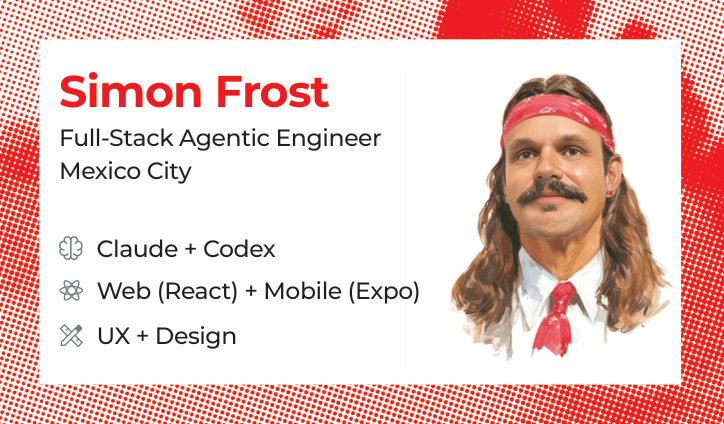
I’m updating my identity to Full-Stack Agentic Engineer. I still ship full-stack code, I just don’t type it manually anymore.
This is a more accurate description of my role, and tech has always been about looking forward. Especially when the shift is as big as specialisation in the industrial age.
Conclusion

Software isn’t the bottleneck anymore. It’s taste, judgement, and domain knowledge that are holding you back. As an eternal optimist in a world where software consumption is ever increasing, I’m excited for humanity’s unexpected future.
Make sure you’re staying ahead. If you’re a startup or founder shipping something interesting and want to move faster, while keeping the same high standards, get in touch — simonhfrost(at)gmail.com.